
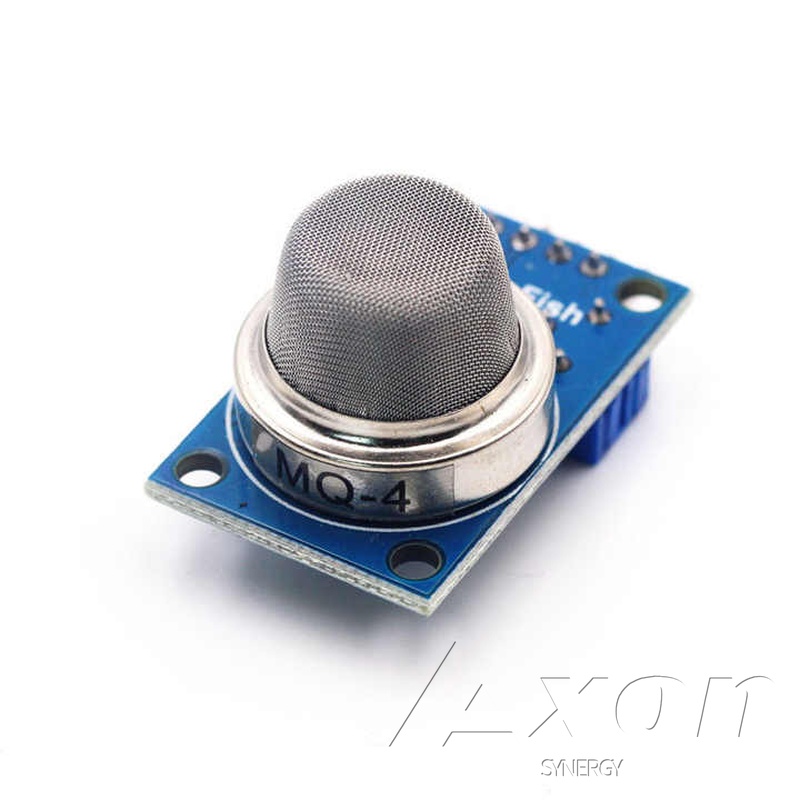
MQ-2 Gas Sensor Module - Smoke, Butane & Methane Detection for Arduino
The MQ-2 is a tin oxide semiconductor gas sensor on a ready-to-use breakout module. It detects a wide range of combustible gases and smoke - including LPG, butane, propane, methane, hydrogen, and smoke particles - across a 300 to 10,000 ppm range. The onboard potentiometer lets you adjust the digital output threshold directly, so the DO pin can trigger your microcontroller without any code-side calibration for simple alarm applications.
The module provides both analog output (AO) and digital output (DO) simultaneously. The analog pin delivers a voltage that scales with gas concentration, enabling ppm estimation in software. The digital pin gives a simple HIGH/LOW trigger when concentration exceeds your set threshold - ideal for alarm circuits and interrupt-driven detection. Two onboard LEDs indicate power status and digital threshold crossing at a glance.
Common project uses: Gas leak alarms, smoke detectors, air quality monitors, kitchen safety systems, and educational sensors. Compatible with Arduino Uno, Arduino Nano, ESP32, ESP8266, and Raspberry Pi with an ADC for analog reading. Requires a 5V power supply and a 24-48 hour preheat burn-in cycle for accurate, stable readings. Our Gas Leak Alarm Project Kit includes this sensor along with the ESP32, NE555, and breadboard components needed for a complete build.
Specifications
| Detection Range | 300-10,000 ppm |
|---|---|
| Detectable Gases | Smoke, H2, CH4, Butane, LPG |
| Output | Analog + Digital (adjustable threshold) |
| Operating Voltage | 5V DC |
| Dimensions | 32 x 20 x 27mm |
| Compatibility | Arduino, Raspberry Pi, ESP32 |
Frequently Asked Questions
What gases can the MQ-2 sensor detect?
The MQ-2 detects smoke, LPG (propane/butane mix), butane, methane (natural gas), hydrogen, and alcohol vapors. It is a broad-spectrum combustible gas sensor, not specific to one gas type. For applications requiring precise identification of a single gas, a more specific sensor such as the MQ-4 for methane or MQ-6 for LPG may be more appropriate.
How do I wire the MQ-2 to an Arduino?
Connect VCC to Arduino 5V, GND to GND, AO to any analog input pin (A0-A5), and DO to any digital input pin. Use the onboard potentiometer to set the DO trigger threshold. Power the board and allow 24-48 hours for the sensor element to fully preheat and stabilize before relying on calibrated concentration readings.
Can I use the MQ-2 with an ESP32 at 3.3V logic?
The MQ-2 sensor heater requires 5V on VCC to operate correctly. Run VCC from a 5V supply even when using an ESP32. The DO output swings to approximately 5V, which exceeds the ESP32's 3.3V GPIO tolerance. Use a voltage divider (two resistors) or a logic level shifter on the DO line before connecting to an ESP32 pin. The AO pin similarly needs a voltage divider for safe analog reading on the ESP32's 3.3V ADC.
Why does the MQ-2 give inaccurate readings right after powering on?
The MQ-2 uses a heated tin oxide sensing element that requires a burn-in period before producing stable readings. Allow at least 24-48 hours of continuous powered operation for initial burn-in. After that, allow 2-3 minutes of warm-up after each power cycle before trusting readings. This is standard behavior for all MQ-series gas sensors.
What is the difference between the AO and DO output pins?
AO (analog output) provides a continuous voltage that varies with gas concentration, allowing ppm-level estimation in code. DO (digital output) is a simple HIGH/LOW signal that fires when concentration exceeds the threshold set by the onboard potentiometer. For a simple alarm, use DO. For data logging or concentration monitoring, read AO with your microcontroller's ADC.