
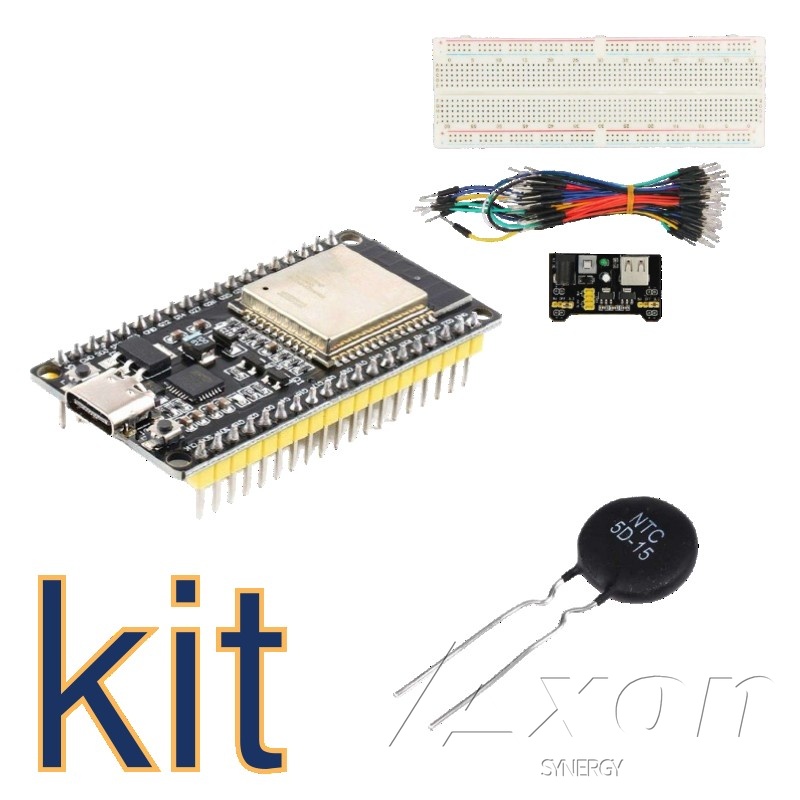
Temperature Monitoring Station Kit - ESP32 + NTC Thermistor + Breadboard
A beginner-friendly introduction to analog sensors, ADC conversion, and WiFi-connected IoT devices - built in about 45 minutes. The NTC 5D-15 thermistor wires into a voltage divider on the MB-102 breadboard with a reference resistor. The ESP32 reads the analog midpoint voltage, converts it to resistance via Ohm's law, then applies a temperature formula to produce an accurate reading in Celsius or Fahrenheit. It is a foundational project that teaches every core skill used in more advanced sensor builds.
With the ESP32's built-in WiFi, the basic sensor reading becomes a connected device: push readings to a free cloud logging platform like ThingSpeak or Adafruit IO, send a phone alert when temperature exceeds a threshold, or run a lightweight web server on the ESP32 that displays live temperature from any browser on your network. All of these extensions are covered in the project guide at no additional cost.
Temperature range and real-world applications: The NTC 5D-15 operates from -55C to +200C - far beyond ambient room temperature. Practical uses include server room monitoring, freezer temperature alerts, greenhouse or grow tent control, aquarium heater verification, and motor or heater safety cutoffs. The complete project guide is in our Projects section with all wiring diagrams, calibration steps, and code.
Specifications
| Includes | ESP32 DevKit + NTC 5D-15 Thermistor + Breadboard + Power Module + 65 Jumper Wires |
|---|---|
| Temp Range | -55C to +200C |
| Connectivity | WiFi for remote monitoring and alerts |
| Accuracy | Typically plus/minus 1C with calibration |
| Difficulty | Beginner |
| Build Time | 45 minutes |
Frequently Asked Questions
How accurate is the temperature reading from an NTC thermistor?
With calibration against a known reference thermometer and the ESP32's 12-bit ADC, NTC thermistors typically achieve plus or minus 1C accuracy across a moderate temperature range. For laboratory-grade precision, a dedicated digital sensor like the DS18B20 (plus or minus 0.5C, digital serial output) is more appropriate and requires less calculation.
How do I send temperature readings to my phone?
The project guide covers two approaches: cloud services like ThingSpeak or Adafruit IO, which accept data via an HTTP request from the ESP32 and display live graphs (free accounts, setup takes about 10 minutes); and a local web server running on the ESP32 that any browser on your WiFi network can access for the current temperature reading. Both are covered with complete code in the guide.
Can I use this to monitor a freezer or outdoor environment?
Yes for outdoor use - the thermistor handles the full range of outdoor temperatures comfortably. For freezer monitoring, the sensor element handles sub-zero temperatures well, but the ESP32 and breadboard should remain at room temperature with the thermistor probe extended into the cold space via longer wire leads. A waterproof probe sleeve would be needed for liquid immersion or outdoor weather exposure.
Does the kit include the reference resistor for the voltage divider?
A 10k ohm reference resistor is not separately included - it is a standard component available for under $0.10 at any electronics supplier. If you have a resistor assortment kit, you almost certainly already have one. The project guide specifies the exact value and placement. All other components needed for the complete build are in the kit.
Is this a good first electronics project?
Yes - this project is specifically designed for first-time builders. The circuit has only three components on the breadboard: the ESP32, the thermistor, and the reference resistor. Wiring errors are easy to spot and fix. The code is short and well-commented. The end result is a genuinely useful device rather than just a blinking LED, which makes completion satisfying and motivates the next build.